
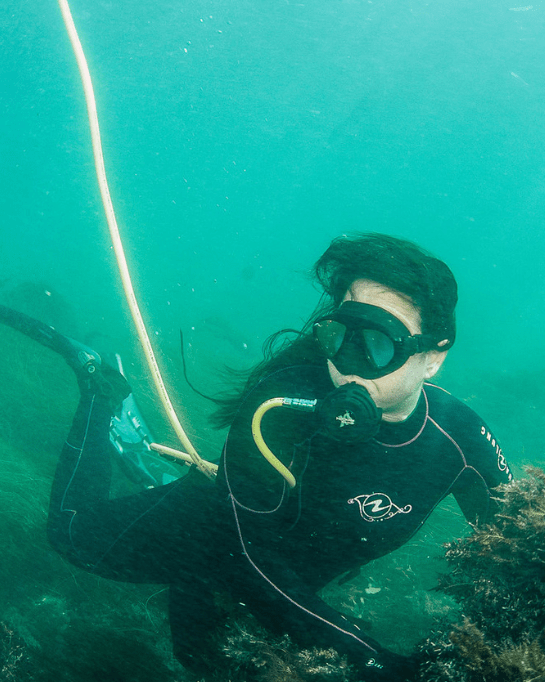
Smoking tobacco hookah is a popular activity, while diving with a hookah system is a different story, diving properly with a hookah system is a completely different story.
This is a translation of my post about hookah diving in Turkish. I thought this very detailed analyzing vision should be presented to a more broader audience.
Hookah diving systems are a type of surface-supplied diving system. Looking back in history, it is a system that everyone has probably been thinking about since the most primitive times of diving, when people jumped into the water and started swimming with their heads underwater.
From the time of the warriors who swam underwater with a piece of reed in their mouth like a snorkel to avoid being seen, until Aqua Lung came on the scene, the only way to deliver air was through a hose from above. Nowadays, we have placed this setup, under the umbrella of surface-supplied diving systems. But today, when it comes to hookah diving, in many parts of the world there is an approach as if these two are not the same thing, and as if hookah diving is a piece of cake. We cannot underestimate the risks in any way while doing activities that we cannot do according to the laws of nature in an environment where we cannot survive by the laws of nature.
If we lose our advantage that adds to this superiority even for a moment, we lose our ability to sustain the life. This point of view, which sees hookah diving as simple, has also spread everywhere in the world. From Turkey to Japan and even in America.
In a surface supplied diving system (SSDS), in its simplest form, the diver breathes from the surface through a hose into which air is supplied. So why is there a difference between SSDS and hookah?
Where does the line lie?
Hookah diving systems are often referred to as Surface Supplied Breathing Apparatus (SSBA) or SNUBA (Surface Nexus Underwater Breathing Apparatus (SNUBA (actually a brand name)). The difference with the system we think of when we say SSDS is that a SSDS system provides more control mechanisms and protection.
There is no certification or standards setting organization in the world for hookah diving, even recreationally. At best, there are user manuals and videos from those who produce such equipment. In fact, there doesn’t seem to be much wrong here, the only thing that needs to be done is to ensure that the compressor that will pump air into the hose works with an energy source and the diver continues to hold the regulator in his mouth.
Hookah systems are only used in non-decompression limits as an unwritten general rule (at least, it is almost never written anywhere). In this case, if the compressor, which is the air source, has a problem with the continuity of operation, because the hose is long and you are already in the NDL (Non Decompression Limit), you can rise to the surface with a few puffs of air left in the hose.
If the compressor is electrically powered, there is no risk of poisoning anyway, and it seems that an EGS is not necessary. Basically, this is a simple issue without much complexity then, isn’t it?

Components of Hookah Diving Systems
Hookah diving systems basically consist of an air source, hose and regulator. For added safety, more auxiliary tools such as pony tubes and seat belts can be included.
-Air Source
In these systems, a low pressure (LP) compressor is often used as the air source. These low pressure compressors can be portable or stationary. They deliver air at a pressure between 30 and 100 psi, depending on the planned depth and length of the hose.

Portable models today are not only wheeled, but also battery-powered and floating.

Compressors can use fuel or electricity to supply air. Electric compressors can be fixed to a boat or battery operated, as in the case of portable floating compressors, and are quieter than fuel compressors.
While most compressors offer limited range of movement because they are stationary when in use, portable versions follow you as you swim, giving you a wide range of movement. Battery-powered versions have easily replaceable batteries and can be charged on board.
Since fueled compressors exhaust carbon dioxide out of the exhaust, there is a risk of poisoning if poorly planned dives and the location of the compressor should be chosen carefully. Care must be taken to ensure that the exhaust outlet of the compressor is always downwind, opposite to the air intake. There have been numerous incidents where divers have been poisoned or killed by inhaling toxic doses of carbon monoxide due to improper construction, incorrect positioning, inadequate supervision or safety precautions.
A frequently preferred feature on this type of compressors is that it does not need lubrication. Compressors can be piston or diaphragm compressors. Depending on the model, diaphragm compressors generally have a lower pressure and do not require lubrication.
Piston compressors have a higher pressure than diaphragm compressors and require lubrication. In such compressors, it is very important that the condition of the filtration system and the oil is selected according to the manufacturer’s requirements and taking into account the effect on human health.
In oil-free systems, this is achieved by coating the diaphragms with a layer of Teflon, a kind of lubricant. Teflon is actually a brand, just like the Jeep. The full name of these coatings is PTFE coating. PTFE, a type of fluoropolymer, stands for polytetrafluoroethylene.
Hookah compressors often include reserve tanks. In most compressors, the motor and tank section are fixed in the hull, while in floating portable compressors they can be positioned with the hose between it and the submersible.
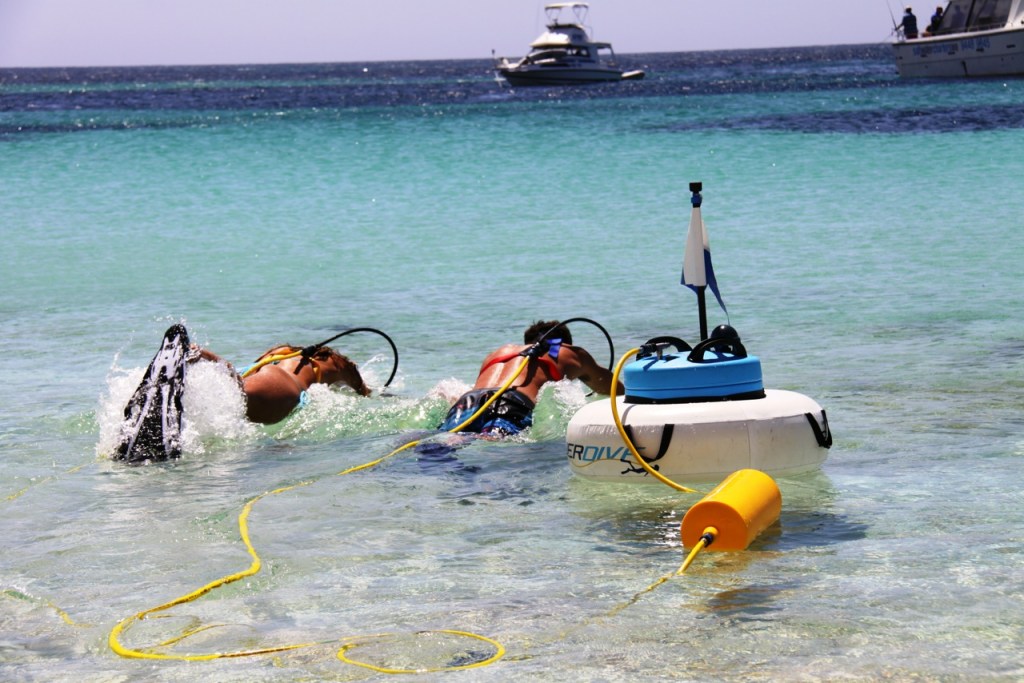
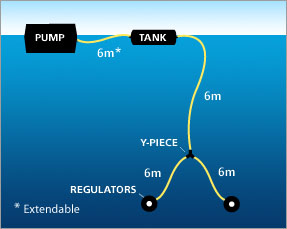
The reserve tank ensures a steady flow of air at a constant pressure. In the event of a sudden engine failure or an irregular operating speed, it ensures that the diver’s breathing is not suddenly affected.
The breathing rate of a diver engaged in intense activity may exceed the compressor’s capacity to supply air, the reserve tank ensures that the required air is supplied at a constant rate and the diver does not experience problems.
The reserve tank also allows the incoming air to expand and cool down. However, these reserve tanks are not large and provide a short-term alternative to the diver in case the engine suddenly stops. Assuming the capacity of the reserve tank as an emergency air supply alternative is an important factor to consider, depending on the planned dive and the number of divers.
This type of system is called a dynamic system. In dynamic systems, air is supplied by a mechanical device. A system in which air is supplied by an electric or fuel-powered compressor is a dynamic system. Passive systems, on the other hand, are systems where air is supplied from a compressed source, i.e. there are no constantly moving parts to supply air.
-Air Hose
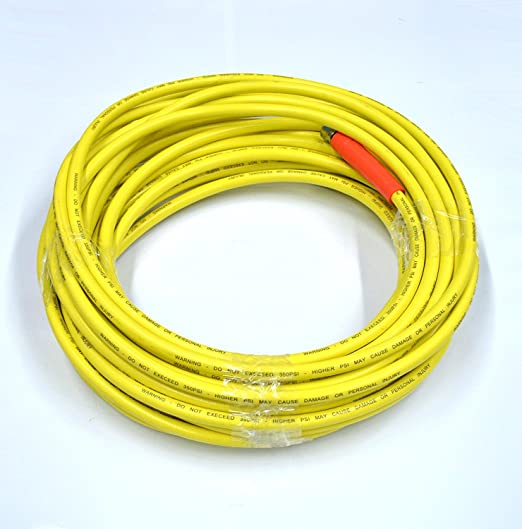
In hookah diving, floating (positive buoyancy) hoses are used as they are generally used in shallow depths and to prevent hose entanglement. The hose used generally has several layers of high strength coating. This makes it resistant to friction, sun, salt water, kinking and entanglement. The hoses used in diving are not similar to the air hoses of compressors in workshops and an improvised hoses should never be used for this purpose.
-Regulator
The regulators used in hookah diving are different from SCUBA regulators. These regulators consist only of a second stage regulator and the main difference is that they must operate at lower pressure.
While a hookah diving regulator operates at 30-100 psi, a scuba regulator that operates at a pressure of 100-250 psi cannot be used without modification because it is much lower than the pressure required to operate if connected to a hookah diving system. If the model is suitable for this modification, it can be made suitable for use by installing and testing the spring suitable for the target pressure by an authorized person.

-Safety Harness
A safety belt or harness prevents the regulator from coming out of the diver’s mouth in the event of a sudden pull of the hose, spreading the strain over the diver’s body and prevents it from effecting only the regulator.
They can be worn around the waist or on the chest. As an alternative to a harness, divers often knot the hose to a weight belt or wrap it around their own waist with a light knot. This practice quickly reduces the strength of the hose in that area as it regularly bends the hose in the same place, and tying it to the weight belt means that if you need to discard your weight belt, you can’t.
This may not be critical for recreational diving in a large, empty, well-visible area, but it is critical for commercial diving in low visibility with random obstacles. Although the weight belt has the task of providing negative buoyancy, being a belt by its very nature, it also carries the risk of snagging on an unlucky day in a confined space. If you don’t have the extra surface-to-diver communication, all it takes is one unlucky day to become part of the research statistics.

-Emergency Gas Supply
An emergency air supply is the solution to prevent accidents caused by a compressor problem during hookah diving. It is often known as a pony or bailout cylinder.
A suitable emergency supply (egs) turns a panic exit into a slow journey to the surface. Compared to the total cost of all the equipment, its cost is relatively small. The emergency air supply should contain more air than the ascending part of the dive plan.

Areas Where Hookah Systems are Used
-Industrial diving
Hookah systems are used all over the world today (yes, even in developed countries). In undeveloped and developing countries, we can often see them being used in commercial diving (especially by compromising the basic safety equipment). Even if the planned operation does not involve intensive work and even if there are no restrictions imposed by law, I think this is a wrong practice.
-Scientific Diving
We can see that scientific divers often use hookah systems depending on which part of the world. In some cases, I was most surprised to see that they were even more unsafe than industrial divers. Maybe it was a recreational diver who was involved to help with the scientific diving in the photo I saw, I don’t know for sure, but it was a professional scientist who used the photo in the scientific presentation.
I would not have expected such a presentation from someone who is professionally interested in science and has developed the ability to sophisticatedly learn and think. In the photo, the diver, who did not have a backup air source, was holding the hookah hose regulator directly in his mouth without attaching it to a seat belt or weight belt or even rollin around his waist. Of course, I don’t know exactly what the divers were doing at the time the photograph was taken, but this raises a second question that we will focus in a moment.
-Recreational Diving
In recreational diving, especially in places such as the Bahamas and Egypt, where diving tourism is very intense, hookah diving can often be encountered. Hookah diving in NDL (Non-Decompression Limits), where visibility is very good, there are no obstacles to get stuck around and there are many people both above and below the water, without an extra backup air source, is perhaps exactly how it should be used.
After all, in the event of a malfunction, there are still a few puffs of air in the hose, there is almost no chance of getting stuck, and there are people both on the surface and underwater who can communicate or physically help in the event of a mishap or warning. The divers probably don’t regularly dive to different depths like a commercial diver, and they don’t suffer from the fatigue of regular hard work, after all they are in vacation in a touristic area.
There is almost no need to even think about the possibility of a decompression because they cannot go deeper than the length of the hose. They don’t have a job that requires a lot of effort underwater. It requires much less training than SCUBA. I think that’s the only case where hookah diving is actually a sensible invention.
-Aquariums
I think one of the most interesting uses is in aquariums. The duties of an aquarium diver are to feed the creatures in the aquarium, to maintain and clean the aquarium itself and systems such as filtration, to observe the condition of all the creatures, and to provide recreational dives for aquarium visitors. Plus mermaid shows, which not all aquariums have.
Sometimes, under the supervision of SCUBA divers, there is a free-diving mermaid or mermaid divers who perform shows by breathing through a hookah system. But mermaids are not the most interesting part of the aquarium headline.
The most interesting part is that OSHA issued a $20,000 fine to the Houston aquarium for failing to use a surface-to-diver communication in a SSDS system, and that dives to maintain the aquarium and feed the fish must meet commercial, not scientific diving standards. The aquarium appealed and won the case, and was supported by the scientific diving community.
-Gold dredgers and Traditional Hunters
Many people have seen divers on television diving for gold by using hookah system and dredging in lakes and rivers. These divers dive in waters that can easily become murky, and the nature of their work involves large pieces of rocks that can move and cause the diver to get stuck. Divers hunting underwater for sea creatures such as lobsters, scallops, aubergines and sponges often use hookah systems all over the world. These areas already have their own complexities before we get to the proper use of hookah diving systems, but until we get to this part of the article, we have already touched on the risk factors that apply in this area.
Places Where Hookah Diving Can Be Used
Actually, it’s pretty obvious for a diver who has been able to put the pieces together so far. In places where visibility is good, where there is no risk of entanglement, jamming and narrow spaces, where there are many people above and below the water, and where the air remaining in the hose can be easily reached to the surface in case of a problem, it seems to be usable with basic training without an extra backup air source. In places where there is a possibility of snagging, jamming, bottom lift, low visibility and an operation plan that will require effort, there should be a backup air source and a dive computer. Someone who is not aware of his surroundings and is not ready for sudden changes cannot be expected to make the right decision in case of a sudden setback. Depending on the situation, it may be much more logical to use a FFM (Full Face Mask) with surface-diver communication, i.e. a true SSDS (Surface Supplied Diving System).
It was a nice coincidence that just as I was writing this article, Kirby Morgan released a video of the M-48 mask with surface replenishment and communications.
When we re-defy the laws of nature, increasing measures to protect human health is the only sensible thing to do. The funny thing is that most hookah system’s promotional videos on Youtube are shot by a SCUBA diver. Hookah divers are accompanied by SCUBA divers and in some videos it is emphasized that the dive guide is a certified SCUBA diver. I think this actually only emphasizes the areas where the system is inadequate instead of highlighting it. It’s even funnier that even some of the hookah diving system manufacturers recommend basic SCUBA training before use.
There are different approaches to whether the hookah hose should be attached to the waist or weight belt, for example, the gold dredgers I^m about to mention advocated that it should be attached to the weight belt so that the hose would not be an obstacle when the weight belt was discarded. But what should happen is that a hose should be connected to a safety belt. In terms of safety belts, there are systems that are both connected to the weight belt and separate from the weight belt. No one has hesitated to do their part to complicate a subject that should be a very simple issue.
Where the Fundamentals Get Mixed Up and the Gray Area
The fact that there are no authorities on hookah diving and that the restrictions on it are not well-defined in almost every part of the world is a big problem. Nowadays, every diver knows about decompression sickness and the importance of taking precautions against suffocation underwater. At the same time, as humans we like to explore boundaries and as divers we like to push them. This leads to black and white rules getting mixed up in the gray area, and from a logical point of view, it leads to scenes where we say “what the hell is this?”.
While doing research for this article, I came across threads in local and foreign forums about how people can make improvised hookah systems from car compressors, workshop compressors, etc. There are even many divers who are trying to do this and search for gold underwater or go hunting.
In the case of OSHA and the Houston aquarium, it is clear that divers who do not dive scientifically, diving in a scientific facility that does not fall under the definition of scientific diving, should choose the standard that should be followed based on what they are actually doing. The issue of hookah diving is actually not that complicated and it is tragicomic that it is often used incompletely in many wrong areas of diving. While SCUBA diving and commercial diving have a lot of organizations and the limits they set, the lack of black and white sharp limits on hookah diving results in people pushing the limits with their imagination.
A piece by Tom Bryant on the Goldgold site about gold dredgers getting stuck underwater actually fits the format of this article very well.
****
If you have ever been trapped by a boulder while dredging, and are still alive to tell about it, then you will likely have a tale to tell that would make people sit up and listen.
For those of you that have never experienced it, let me try to tell you what it is like:
There is no noise, and very rarely is there any warning. A horrible, crushing weight comes down on you, like “Jaws,” and you get a sick feeling in the pit of your stomach as you instinctively try to pull yourself free. You try to tell yourself to keep calm, but the shock of the pain as the boulder crushes your leg or arm, joined with the realization that you have very few escape-options, makes you hyperventilate. You cannot seem to get enough air through your hookah regulator.
If your airline is also pinned under the rock, you might find yourself with no air at all! You try to pull yourself free, but there is no place to push against; and the rock is not moving. If you have not already drowned by now, or been so badly hurt that you can no longer function; reason will slowly return, and you will start thinking hard about what your resources are and what remaining options you have. “How much gas do I have left?” “Am I caught, or is a piece of my equipment caught?” “Can I use the dredge to suck away a channel to free myself?” “Where the heck is my diving partner?”
The biggest danger facing the trapped diver is time. How long until the air runs out? Your whole life is tied to your hookah airline and the dredge motor. This is a good reason to take suction dredging on with the right approach in the first place, making sure to keep all your dredging gear in a good state of maintenance and repair.
A trapped diver needs time. As long as he has air and has not sustained a fatal injury from the accident, he can wait it out underwater until he starves to death. Here follow some good ideas when you find yourself dredging around big rocks. Some of these ideas will buy you time. Some will help you avoid serious problems in the first place. Some will help get you out of trouble if you are having a bad day:
1) It is always a good idea to work with a buddy.
2) Your buddy should have a source of air. If you are dredging in water that is too deep for your buddy to stand waist deep, how else can the person stay underwater to help you? This could involve an extra hookah line on the dredge and/or even a scuba tank with regulator which is ready to go in the event of an emergency.
3) Unless your buddy is the incredible hulk, you should have the basic tools for moving large rocks. At the very least, a long pry bar and a few wedges. Few people realize the great advantage that a wedge can provide. Wood and plastic wedges can sometimes be hard to use underwater, because they try to float away. I suggest having a metal wedge or two on the dredge site.
****
Boat owners who want to clean under their own boats easily and cheaply are also fans of hookah diving. Although the job is simple, you should not defy the laws of nature without having more than one emergency plan. Setting up and storing the system is probably less challenging and less risky than a SCUBA system. Without basic safety precautions such as a backup air supply, a dive knife, someone on the surface who is aware of what is being done and ready to assist, such a venture could result in death on an unlucky day. Even with the SCUBA system, which, unlike the hookah system, has almost unlimited movement, divers can get stuck while cleaning boats or pools, get stuck and die, or have near-death experiences.
As with OSHA and the Houston Aquarium, aquariums have their own differences of opinion in between their world. While the Houston Aquarium uses a hookah system in the aquarium, and the aquarium divers who defend it on the internet say that the tube restricts them and there is a risk of crashing into things, in our country aquariums often use SCUBA. I am sure they also have arguments in favor of SCUBA too. I would love to make a more detailed comparison if I had information about the method they use in their aquariums in the rest of the world. But it seems that the subject of aquarium divers is a subject that has not been sufficiently studied and sharp boundaries have not been drawn.
How to Use Hookah Diving Systems Correctly
Actually, we talked about it piece by piece in the article until we got to this part of the article, but if we need to collect them all in one place;
-The hookah system should not be setup by an untrained person on person’s own, especially not with improvised parts.
-No matter what the purpose of the dive is, under no circumstances should you dive alone in a hookah system. You should always have a buddy or a team on the surface who is aware of the action being done and ready to support.
-Whateverunderwater goal is, you should have more than one emergency plan ready.
-The regulator, hose and hookah compressor to be used must be manufactured for this purpose.
-It is a good idea to have a ponny tank or an extra hose nearby or as part of the dive depending on the plan and environmental conditions.
-If it is a gasoline model, care should be taken to position it according to the wind direction and be prepared for the wind direction to change.
-Under no circumstances should anyone be allowed to interfere with the operation of the hookah compressor. Wherever necessary, warnings should be placed on the compressor and the extra parts that make it work.
-If you use the tactic of wrapping the hose around the waist or weight belt, remember to factor into your future plans the effect that the frequently bent areas will wear out much more quickly and that the durability standards of the hose will not be equal in all areas.
 Bubble Of The Bottom