
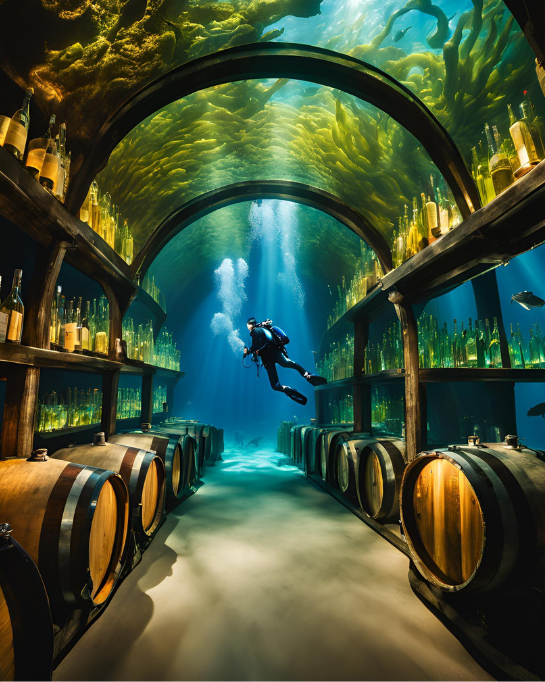
I know what you are thinking! You definitely think that you are going to read an interesting and little known article, which is born from the intersection of multiple fields and is most likely the subject of the future.
The subject of this article is such that everything about it is nothing more than an illusion. Underwater wine tourism, which you think belongs to the future, has already been tried in the past. As everyone knows, “there is nothing new under the sun”. Or do you think there is?
I remember an expression such as “bubble of the bottom”, I wonder where I got it from? In this article we will briefly examine wine storage of the bottom and the wineries that do it.
When you think of underwater wine tourism, two things come to mind. One is a vision that starts by evoking pirate treasures at the bottom and moves on to the presentation of luxury wines, and the other is underwater storage and access to this storage at any time. You have already understood the first idea of the intersection cluster. When it comes to underwater wines, everyone is wrong! Wine is a very special field in itself and I am not an expert in this field. The funny thing is that wine producers or gourmets are not experts in the underwater field. If you ask me where I learned this, I learned it from the research process I went through in order to be able to present this article to you. But if there is one thing that these people definitely know, it is storing and tasting wine. So how long has this idea been in the sun?
Underwater wine storage is generally carried out by manufacturing a metal storage vehicle in the form of a skeleton or cage and aging the wines underwater, sometimes with an extra cork protector.
Case-1 New York Times Says Hi! They Say Wine Goes Well with Fish
If you want to review the original article, here is the link
According to a New York Times article I came across, Italians, whose famous in wine and in the underwater world, first thought of this in 2008. It seems that this idea has been waiting in the sunlight for a long time and, as you will see in a moment, has been rediscovered frequently.
I definitely recommend reading this article if you are interested in this interesting underwater intersection. Because there are really different ideas in this area, but everyone seems to think that the punch line is only in pouring the bottle into the glass. I disagree.
The story of our first visionary, Piero Lugano, who opened a winery called Bisson in 1978, started by talking about this crazy idea with the Italian Minister of Agriculture in 2008. Lugano, who was 63 years old at the time, started to examine the idea with scientific diver academics from the University of Genoa after the Minister of Agriculture liked the idea. As you won’t be surprised, the first reaction of the academics was that this could not be done. According to the NYT article, one of the academics, Dr. Fanciulli, said, “We are not trying to put more glass bottles underwater, but to reduce the number of glass bottles that will go there.” Afterwards, the excitement of the young scientists and the chance to draw attention to underwater life with this project and the conclusion that it would not have any effect on the balance underwater according to their analysis, they decided to put this project into practice.
In May 2009, they began storing 6,500 bottles of 2008 sparkling wine, produced using a sugar-free method called “pas dosè,” in stainless steel-framed storage tanks at a depth of 200 feet (60 meters) in a bay known as Cala degli Inglesi.
At the time, no one had any idea what the outcome would be for this first-of-its-kind project.
When they were taken out of the sea to see the results after 13 months, no negative effects were observed on the sea, and even a lot of marine life was observed to have formed on the storage frame and glass bottles.
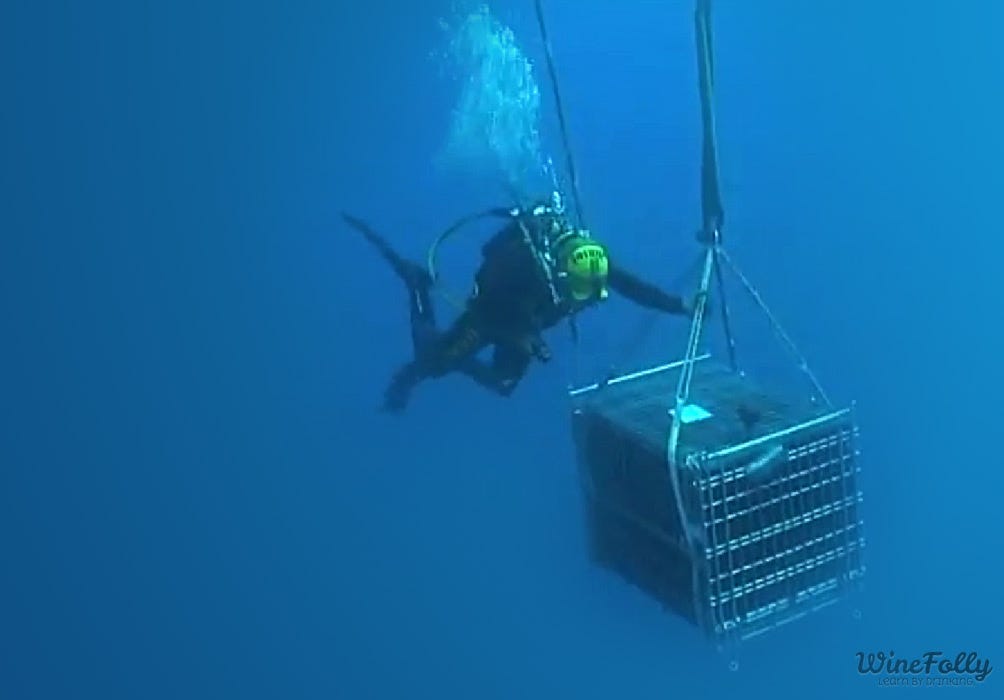
This video was also added to the New York Times article. When we examine it, we can see the divers wearing industrial helmets wearing Kirby Morgan placing the steel storage cages of the wines and then the scenes of the removal. There are also divers diving with scuba systems and shooting with professional cameras. I think the most interesting thing is that they also used a very strange looking ROV for the imaging. The industrial diving company chosen for this stage of the wines was called Drafin Sub.
Although it was a fairly ordinary day for an industrial diving, I am sure that it was a project that everyone was eagerly waiting for the results of.
When they took the cages back out, they saw that a lot of marine life had taken over them. Many creatures such as seaweed, algae, starfish, shrimps, mussels made these cages their home. The New York Times article presented this as a positive impression for the sea. However, as we see in the scenes of the lowering and removal of the cages, there was a short-term disturbance to the marine life. Since they received scientific assistance from the University of Genoa, I think they were careful to ensure that the marine life in the area would not be harmed during the lowering and removal of the cage.
This article does not mention any taste differences or extra special methods in wine, but it is certain that it can be considered as the beginning of a very interesting field. Looking at our second article that we will examine shortly, we can say that it is difficult to say who first came up with this idea in the Mediterranean region, but it definitely has an audience. And everyone did not hesitate to carry out their own experiments.
Case-2 Wine Fooly
If you want to review the original article, here is the link
In 2008, in another part of the world, in Los Angeles, a tasting event was offering wines aged underwater. The boss of the author of the next article was very surprised by these wines at the event and bought a bottle to try with him.
These wines were produced by Raul Perez under the brand name “Sketch” for that day. The winery, located in the Dena region of Pontevera, Spain, was also very close to the sea.
This winery uses a different approach than others, which is to age the wine underwater. After the wine is made, they only age it for 60 days at a depth of 30 meters underwater.
I think both of these articles mentioned that the way the wine bottles are placed in the cage causes the bottles to shake slightly with the current, which actually helps by keeping the sediment in the wine moving.
This Wine Folly article from 2012 also mentioned a list of brands that age wine underwater, and I’m including that list here because I didn’t expect to see so many brands. I don’t know if they still actively use this technique or if the brands are still producing.
“Bisson Abissi Prosecco from Liguria, Italy
Raul Perez Sketch from Dena, Spain
Château Champ des Soeurs et l’Abbaye Sainte-Eugénie in Fitou, France is a white Corbieres with a synthetic cork by Nomacorc
Louis Roederer (the makers of Cristal) sunk a lot of champagne in the Bay of Mont Saint-Michel in Normandy, France where temperatures maintain an even 50° F
Chateau Larrivet Haut-Brion experimented aging a 56 litre barrel of Bordeaux in the Bay of Arcachon calling it “Neptune”
Gaia Winery on Exo Gonia Island in Santorini, Greece
Henri Maire from Arbois, France has submerged wines in an ancient underwater Abbay in Lake of Vouglans, France’s 3rd largest man-made lake
Mira Winery aged their Napa red wines for 3 months in Charleston Harbor, South Carolina”
The Wine Folly article states that only white and sparkling wines are known to be aged underwater. However, as we will see in the following sections, the “Underwater Wine” brand, which is actively producing and selling today, uses the underwater aging process on red and white wines and has turned this into a marketing tactic..
When I read the articles mentioned as references in the Wine Folly article, neither in Wine Foly nor in a second source does it mention any precautions to protect the corks of the bottles. The reason I mentioned this is that I came across additional precautions taken in one of the sources I researched to prevent the corks from being affected by salt water. In addition, in this blog post mentioned in the reference section, it is written that a slight saltiness was noticed during the tasting. If the outside of this bottle was not cleaned after leaving the sea, this could be an effect caused by the light contact with the outside of the wine while it was being poured, if there are marine organisms on the outside of the bottle, there could be a smell spreading from there, or in general, I think it could be interpreted as just a psychological imaginary expectation. In general, no significant difference between the normal methods and the others has been mentioned anywhere, but everyone has tried it with the hope of getting a different result.
As we see in this article written in June 2008, the Frenchman Louis Roederer decided to lower champagne to a depth of 15 meters (the water temperature at that depth was 10 degrees Celsius) and keep it there for a year. He saw the advantage of the fact that it was generally cold underwater and would sway slightly due to the currents.
This article describes a relatively longer experiment by unnamed French wine producers. Although the total number of bottles is not stated in this article written in May 2008, a depth of 60 meters was chosen for aging. They aimed to bring 24 bottles to the surface every 20 years and observe the effects on them, and set the end of the experiment as 2055. The interesting part is that this article states that 20,000 bottles were distributed to different parts of the world the previous year (2007) in order to see the effects of different aging conditions, and some of them were kept at -40 celcius in the poles. Apparently, keeping wines in interesting conditions is not just an intersection related to underwater.
Case-3 Wine Cellar

If you want to review the original article, here is the link
The most technically loaded of all the articles is our next article. It is mentioned that the best temperature for wines to be aged is around 12–14 degrees Celsius, and that underwater is an ideal environment because it naturally offers these degrees continuously and relatively stable. It is also mentioned in this article that increasing pressure accelerates the aging of the wine. However, considering that it will be published in 2024, I cannot be sure whether this is theoretical information or a suggestion from an artificial friend. No such significant difference has been mentioned in all other sources.
This article offers us 3 examples of wineries aging wine underwater:
The Croatian brand Edivo Vina has taken the subject of underwater wine aging to another level. When they lower the wine into the sea, they do so in ancient ceramic wine bottles called amphoras, which is the Roman wine method. They have given this wine, which they call sea wine, a very special name, Navis Mysterium (The Sea Mystery) in Latin, and “Sea Mystery” in Turkish.
On the other side of the world, Mira Winery in Napa Valley, California, began its “Aquaoir” experiment, known as the Neptune Project, in 2013. They claim to be the first winery in the United States to age wine underwater. They aged their wines for 3 months at 18 meters in Charleston Harbor and offered them for sale in July 2013, starting with members of their own club.
Even more interestingly, they wrote a blog post about how other interested wineries could do such a project, with a price tag of $2,200 for a full cage of 12 wines and $500 for sets of two, one aged underwater and one aged on land.
Case-4 If the Europeans wont stop, will the Chinese stop?— Sea Floor Storage

Link to the manufacturer’s official website and about us page
The Sea Floor Storage project, founded by Golden Times Winery in 2015, started when they got the first spark about this subject from the story of the wines inside a ship that sank in the Baltic Sea. When they looked around the world, they decided to make an initiative in this regard because there were very few sea floor wine aging projects and none of them were produced in their own country, China.
Located in Penglai district, the winery decided to use the region’s marine resources to highlight the quality grapes and coastal features of one of the world’s important grape coastlines. By aging the wine in this way, they decided to take a piece of China’s underwater wine tourism industry pie. This was considered a new initiative even for China.
The team launched the project by researching data such as water temperature, ocean currents, waves, water depth, weather and other factors, and after numerous data analyses and tests, they developed storage vehicles and launched the first batch of their seabed-stored wines in 2018.
Case-5 Underwater Wine
Link to their official website
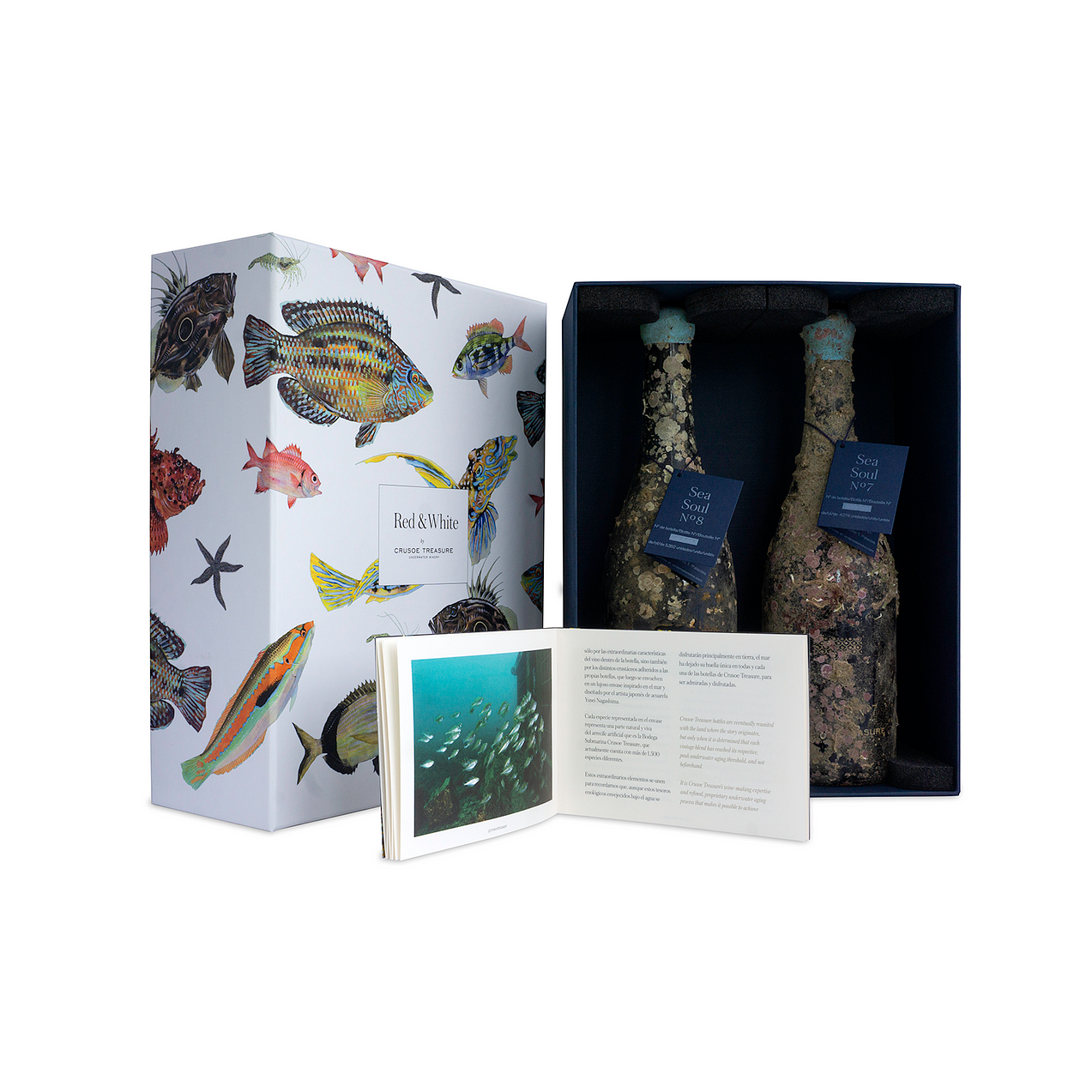
Another project that is actively selling and producing is the Underwater Wine brand located in Montenegro. The first thing that caught my attention was that they seal the corks of their wines with a type of wax seal that they call “sealing wax”. They mentioned that they do this to prevent marine life from forming on the cork.
They have a very interesting website and promotional videos, but they haven’t provided much detail about their projects. However, their marketing-focused articles on the blog section of their website are quite interesting and show that they are a brand on the rise.
Additionally, as stated in the promotional texts of their wines, it has been observed that less marine life forms on the bottles in areas where currents are stronger.
UNDERWATER WINE EXHIBITION? You’re making this up, man!
As we have reached the end of the article and the known information on this subject, we have come to the point where I share another vision at the farthest ends of the intersections, based on the authority given to me by artificial intelligence.

During one of my dives, I had the chance to dive into one of the dive sites known as underwater museums, where sculpture-like art figures are placed underwater. Before I did that dive, when I learned about creating artificial dive sites, I thought that something like this must definitely have been done. When you think about it, most of the dive sites that are easily accessible and contain man-made figures are artificial dive sites.

If we already know how to create artificial diving spots, and if underwater wine aging has a gravitational effect on its community, why not turn it into a long-term event with a before, a peak and an after?
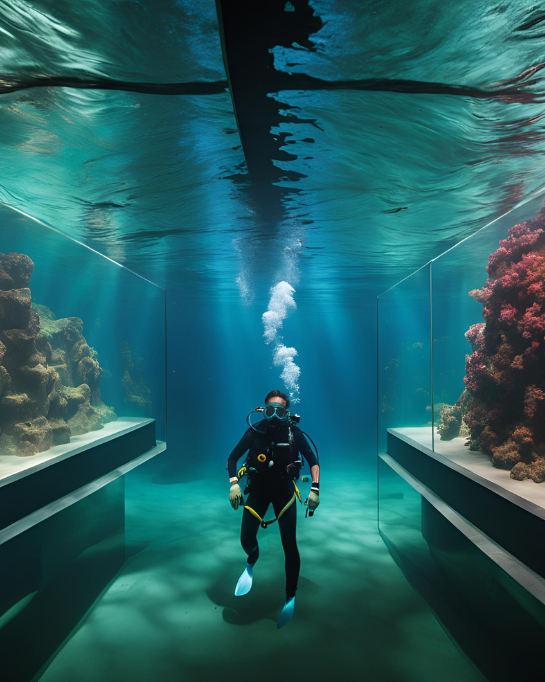
Especially for a country with a very deep history like ours. I think that the exhibition I dream of, with metal signs briefly explaining the wine culture of these lands, and historical representation figures visually prepared for the risk of any human intervention and of course the deterioration of the sea behind them, and finally cages where representative wines are kept, could create a very interesting and internationally interesting diving point and a very legendary experience tour.
If You Ask Where Is The Intersection With Data Centers?
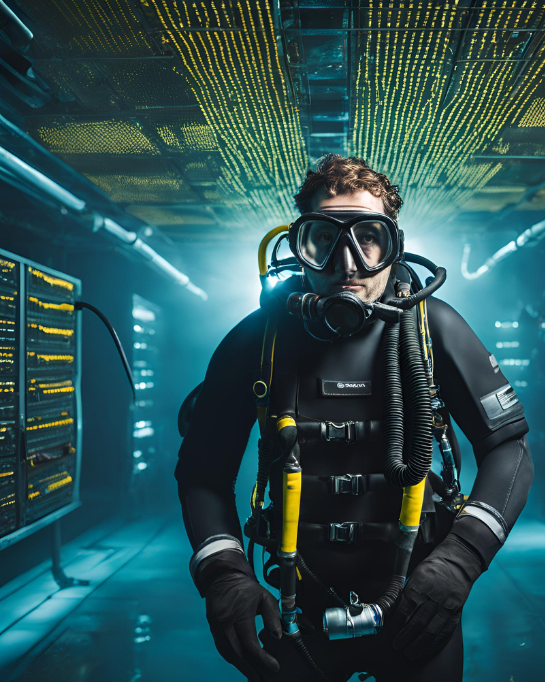
Some female visionaries and companies like Microsoft are experimenting with the idea of storing data centers underwater, just like wines. Who would have thought that wines and data centers could meet at a common intersection? That’s a topic for another article. Spoiler alert, I think this idea will catch on.
 Bubble Of The Bottom